
Eye On Ohio:
The Informed Citizen's Guide to the 2004 Election
December 2004
Almost two months have passed since the Presidential Election, on November 2, 2004. The day after the election, the mainstream media and most of America let out a collective sigh of relief that President Bush had collected over 270 electoral votes, and that he had a three million vote "mandate". There would not be another Florida; no more hanging or pregnant chads, no more litigation, no more uncertainty. The media was all too happy to accept the election, and after November 2nd, pundits moved on to more important issues, like Scott Peterson or Paris Hilton. Americans, too, were glad to put months of bitter campaigning behind them, and went about their daily lives.
But for a small and vocal minority of Americans, November 2nd changed everything.
For the reasons set forth below, these Americans believe that President Bush did not win Ohio's 20 Electoral Votes, and possibly did not win in other states as well. They believe John Kerry was the legitimate winner of the 2004 Presidential Election.
Labeled conspiracy theorists, sore losers, and "dissidents" by the media, they have spent the last two months gathering data and investigating "irregularities." There are dozens of websites that seek to compile the daily evidence of such irregularities, filled with links upon links to charts or articles. The purpose of this paper is to provide an overview of the evidence collected so far Here, in these pages, are the fruits of their labor, as well as other data and information that bring into doubt the claim that the 2004 was a "clean and legitimate" election. The focus is on Ohio primarily because it was the last state called, thus putting President Bush over the 270 votes needed to win. Also, other circumstances surrounding the Secretary of State and highly publicized instances of irregularities make Ohio the ideal candidate for closer examination.
If you are looking for a smoking gun here, you will not find it. Instead, you'll read about a series of complex and seemingly impossible events, from voter suppression, to vote tampering, to possible cover-ups. It is the totality of the circumstances that compel, at the very least, a full-blown Congressional investigation into the matter. Is this enough evidence to cast doubt over the election of George W. Bush? Was Ohio really a "blue state" in this election? As you read, you'll realize that the weight of the evidence strongly suggests such a conclusion.
And so, let's begin1...
Table of Contents
Fraud Defined
Legal Definitions
Fraud: n. the intentional use of deceit, a trick or some dishonest means to deprive another of his/her/its money, property or a legal right.2
Constructive fraud: n.when the circumstances show that someone's actions give him/her an unfair advantage over another by unfair means ... the court may decide from the methods used and the result that it should treat the situation as if there was actual fraud even if all the technical elements of fraud have not been proven.3
Common Definitions
Fraud: n. A deception deliberately practiced in order to secure unfair or unlawful gain.4
Fraud In Law: n. fraud that is presumed from the circumstances although the one who commits it need not have had any evil intent.5
Ideally, the discussion here will demonstrate--to some degree--that there was an attempt by various individuals, as possibly coordinated attempts, to "dishonestly deprive people of their legal rights." In our justice system, the standard of "reasonable suspicion" is the standard used to determine if the police can stop your car and search for drugs, sometimes if a warrant can be issued for you arrest, etc. Basically, it refers to the facts or circumstances which would lead a reasonable person to suspect that a crime has been, is being, or will be committed.6 Is there reasonable suspicion of a crime (i.e. fraud) here? Would a reasonable person, upon reviewing the following, suspect a crime has been, or is being, committed?
Any of these would give rise to a reasonable suspicion that fraud has been committed, and would prompt an investigation. Yet, despite all this, there has not been any real investigation by the proper authorities into this issue.
For all those saying that there is not enough evidence to investigate, realize that what was described in this paper would be enough to issue warrants, to interrogate individuals, to possibly arrest. For all those crying out that there is no actionable fraud, realize that legally, there is not only a reasonable suspicion, but likely probable cause to believe fraud occurred in Ohio.
Finally, for those who say there hasn't been definitive proof of fraud, it must be said that asking for proof of fraud before it's been investigated is illogical. The evidence presented here, the totality of the circumstances, is such that the burden should now shift to the implicated parties to prove that the election was clean and legitimate.
Setting The Stage:
Florida's Aftermath and
How Not As Much Has Changed As You Think
More Floridians voted for Al Gore than George Bush in the 2000 Presidential Election.7 Yet in a frenzy of dimpled chads, butterfly ballots, and midnight hour court decisions, George Bush received Florida's electoral votes and became President in one of the most bitterly divisive elections in U.S. history.
The 2000 election proved that the U.S. election system was critically flawed. On October 29, 2002, the Help America Vote Act (HAVA) was signed into law. Its goals were to (1) improve voting equipment; (2) provide training for election workers; (3) provide voter education programs for the publics; and (4) establish and Election Assistance Commission (EAC) to serve as a "national clearinghouse and resource for the administration of Federal election."
Yet like many ambitious endeavors, HAVA had severe setbacks prior to the 2004 election. Under the Act, the four Commissioners were to be appointed by February 26, 2003. Their nominations were not even sent to the Senate until October 3, 2003, and they were not confirmed until December 9, 2003. Due to the delays in the appointment of the commission, several critical deadlines specified in HAVA and meant to protect voters in the 2004 election were missed:
Representative Rush D. Holt (D-NJ) stated in April 2004 that the "[HAVA] is a very important step, but it is terribly underfunded... [t]he appropriations have not come close to matching what the authors of that bill said was necessary." Most disturbingly, failure to fully fund HAVA prior to the 2004 election resulted in the suspension of voting machine testing by the National Institute of Standards and Technology. Moreover, 24 states requested and were granted waivers for compliance with HAVA voting equipment requirements until the first Federal election after January 1, 2006. Thus, while it appeared to the public that Congress was doing all it could to avoid another "Florida," the reality was that prior to the 2004 election, mismanagement, inefficiency, and vulnerability remained the status quo of our election system.
Pressuring For A Paper Trail
"We conclude that, as a society, we must carefully consider the risks inherent in electronic voting, as it places our very democracy at risk."
- Aviel D. Rubin, Professor, John Hopkins University
Prior to the 2004 election, many expressed a deep concern about the lack of a paper trail in electronic voting. Spearheading the effort to require a paper trail for electronic voting was Representative Rush Holt (D-NJ). In 2003, Representative Holt introduced the Voter Confidence and Increased Accessibility Act. As an amendment to Help America Vote Act its purpose was to "require a voter-verified permanent record or hardcopy under title III of such Act, and for other purposes."8
In addition to requiring a verifiable paper trail, the Act also prescribed that "[n]o voting system shall at any time contain or use undisclosed software... Any voting system containing or using software shall disclose the source code of that software to the Commission, and the Commission shall make that source code available for inspection upon request to any citizen."9 Beyond requiring disclosure of the source code that records our votes, the bill went even further in protecting the integrity of electronic voting by prohibiting voting systems based on wireless communication and that "all software and hardware used in any electronic voting system shall be certified by laboratories accredited by the Commission."10
The Voter Confidence and Increased Accessibility Act had 157 co-sponsors from throughout the nation.11 Yet it never came to the House floor; in early 2003, the bill was referred to the House Committee on House Administration, where Representatives Dennis Hastert (R-IL) and Tom Delay (R-TX) never let the bill see the light of day. A parallel bill in the Senate was also essentially stonewalled in Committee. Despite its paramount importance, neither bill was even brought to the floor prior to the 2004 election.
In Diebold We Trust
"Why am I always being asked to prove these systems aren't secure? The burden of proof ought to be on the vendor. You ask about the hardware. 'Secret.' The software? 'Secret.' What's the cryptography? 'Can't tell you because that'll compromise the secrecy of the machines.'... Federal testing procedures? 'Secret'! Results of the tests? 'Secret'! Basically we are required to have blind faith."
-Dr.
David L. Dill, Professor, Computer Science
Stanford University

Do you know Bob and Todd? Well, you should, because chances are, they counted your vote this year. Or didn't count it.
Bob and Todd Urosevich are two brothers, who own two different voting companies which counted 80% of votes cast in this election. Bob is Vice-President of Diebold. Todd is President of ES&S. One family, counting 80% of America's votes. It is important to note that there is no federal agency regulating the voting machine industry. These two companies then have essentially a carte blanche with respect to how they decide to conduct our elections.
Understandably, one would want only the most neutral and honorable people counting our votes. We should entrust our highest democratic ideal only to those who demonstrate they have the integrity to protect it, right?
Even a cursory examination of Diebold and its history raises red flags, and seriously puts into doubt Diebold's ability to run a fair and honest election:
The evidence shows that a convicted hacker, along with other felons, were the key players in developing the software used in the 2004 election. Furthermore, Diebold has had a history of lying to public officials15 and producing highly hackable voting machines. In is interesting to note that while Diebold makes ATMs, checkout scanners, and ticket machines16 (all of which log each transaction and can generate a paper trail) Diebold has refused to put paper trails on its voting machines. More on Diebold's possibly criminal behavior is examined in the Ohio recount section below.
 So while
Bob & Diebold were busy putting unverifiable software on
machines a chimp could hack17 (no, seriously.
Follow the footnote for a link to a movie of a chimp hacking into a
Diebold machine), Todd & ES&S were having their own
"preparations" for the 2004 elections.
So while
Bob & Diebold were busy putting unverifiable software on
machines a chimp could hack17 (no, seriously.
Follow the footnote for a link to a movie of a chimp hacking into a
Diebold machine), Todd & ES&S were having their own
"preparations" for the 2004 elections.
In May 2004 the Miami Daily Business Review reported that an official, Orlando Suarez had found a "serious bug" in ES&S election equipment nearly a year earlier. ES&S had known about this serious bug for nearly a year and had not fixed it. In his memo Suarez wrote "In my humble opinion (and based on my over 30 years of experience in the information technology field)... I believe that there is/are a serious 'bug' in the program(s)that generate these reports making these reports unusable for the purpose that we were considering (audit an election, recount an election and if necessary, use these reports to certify an election)."18
Why would a company be aware of a flaw which would make audit and recounts impossible, and not fix it, even though it had a year's notice? Well, perhaps it's helpful to know the people who are counting our votes.
 There's one
more company worth a closer look. Triad is an Ohio-based county
that provides the state with its central tabulators and scanning
equipment. Triad is owned by Tod Rapp, who has donated money to
both the Republican Party and Bush's campaign. Triad manufactures
punch-card voting systems, and also wrote the computer program that
tallied the punch-card votes cast in 41 Ohio counties this
election.22
There's one
more company worth a closer look. Triad is an Ohio-based county
that provides the state with its central tabulators and scanning
equipment. Triad is owned by Tod Rapp, who has donated money to
both the Republican Party and Bush's campaign. Triad manufactures
punch-card voting systems, and also wrote the computer program that
tallied the punch-card votes cast in 41 Ohio counties this
election.22
 |
As will be explained in more detail below in the Ohio recount section, Triad is being investigated for fraud in its tabulation of the Ohio vote. |
|
Figure 1: A map representing Triad's influence on Ohio elections. |
Taking it One Step Further
Just because these owners of the voting machines are all blatantly partisan Republicans, just because they all seem to be extreme fundamentalists, just because many of the them are convicted felons, just because they control our voting machines... that doesn't mean that they fixed the election, right? To make the jump from extreme partisanship to letting that partisanship influence one's professional behavior is admittedly a big leap, one that has gaps which must be proven in a court of law with clear and convincing evidence.
But here is some information to help narrow the gap in the meantime. It is against this backdrop of historical "glitches" and "oddities" by these companies that we should evaluate the 2004 election:23
Starting From Behind
"Millions of votes are thrown out in election after election in this country. Now that's a story."
- Andrew Lack, at a Congressional hearing on the networks' 2000 election night miscalls
On November 1, 2004, John Kerry was already down by 1 million votes.37 Secretaries of state, usually the chief election official at the state level, in four battleground states - Michigan, Missouri, Florida, and Ohio - were placed at top chair positions by Bush-Cheney '04, Inc. They all have been accused of manipulating state election laws to restrict voter access on behalf of Republicans. Below are some of the carefully calculated steps taken to silence thousands of voters; those disenfranchised were traditionally more likely to vote for Kerry than for Bush.
Felons who have served their time could not vote in the 2004 election.
In the battleground states, the votes of prisoners, inmates, those on probation, parole or former felons could have changed the outcome -- that is if they could vote. A disproportionate number of those disenfranchised are black.
Blacks account for two-thirds of the disenfranchised felons in both Ohio and Pennsylvania. The analysis, based on data collected by Chris Uggen and Jeff Manza in a report entitled "Democratic Contraction? Political Consequences of Felon Disenfranchisement in the United States,"38shows that Florida, with its strict laws on felon voting, has the highest number of blacks who can't vote because they are serving time or have served time in past.
Registered? Are you sure?
"If you bring back a bunch of Democratic cards, you'll be fired"
- Adam Banse, on his instructions at Sproul & Associates
Voting registration on both sides was fierce this year, but several incidents of the destruction of Democratic registration forms were particularly disturbing. It is illegal to tamper with voter registration cards, which are numbered and issued by local election officials. In some states such acts are felonies.50 At Sproul & Associates -- which operated heavily in such battleground states as Ohio, Pennsylvania, and Nevada -- employees were specifically told not to bring back Democratic registration forms. The firm received nearly $500,000 from the Republican National Committee, but dozens of Sproul canvassers complained they never were paid.51
Another instance of suppressing the Democratic vote occurred with Voter Outreach of America, which was paid by the Republican Party to register voters. It was discovered that the group literally trashed untold numbers of Democratic registration forms.52 While the GOP claimed it had not sanctioned the action and that it was an isolated event, similar problems were alleged elsewhere.53 And the same GOP-backed group was tricking voters across the nation. In Oregon, Nevada, and elsewhere, the group used the name America Votes, which is actually the name of a Democratic organization; presumably this was done to make Democrats think they were registered, even though their forms may have been destroyed or not processed.54
There were not only suspicious activities in the collection of registration forms, but also in how they were processed -- or not processed -- by the respective Secretary of States. Just days before the election, the Citizens Alliance for Secure Elections and the Alliance of Cleveland HUD Tenants, along with seven residents of heavily Democratic Cuyahoga County, had sued the Cuyahoga County Board of Elections in Federal court and claimed that the Election Board employees failed to enter new registrations onto the voter rolls, or to update changes sent in by voters, or to enter addresses correctly. The Board also failed to notify the applicants of any potential problems. The suit asked the Board to place the voters correctly on the rolls before the election. However, this was not resolved before Nov. 2. Cuyahoga County had three times as many new registrants as in 2000, and it is unclear how many were surprisingly "not registered" when they went to the polls.
There's more suspicious tactics used in Ohio in preparation for the 2004 election. In Cincinnati, some 150,000 voters were moved from active to inactive status within the last four years for not voting in the last two Federal elections. This is not required under Ohio law, but was an option allowed and exercised by the Hamilton County Board of Elections. These "unlikely" voters were the ones that were being targeted by the Democrats to "get out and vote."55
Calculated Efforts to Limit the Number of Absentee Ballots
Despite attempts to decrease Democratic voter registration, there were an unprecedented number of newly registered Democrats ready to vote on November 2. Now, the tactic shifted to preventing duly registered voters from casting their ballots.
Ohio Secretary of State and Bush-Cheney '04 Campaign Chair Kenneth Blackwell issued an order that anyone who did not receive their absentee ballot could not vote by provisional ballot on election day. There were thousands of voters who -- through fraud or mistake -- did not receive their absentee ballots prior to election day, and the Blackwell order essentially deprived them entirely of their right to vote. Blackwell was sued in Federal court, and the judge finally granted a temporary restraining order in the case (White v. Blackwell). But this order came down at 2 p.m. on Election Day; prior to that, anyone who had not received their absentee ballot was simply not allowed to vote. The TRO ordered Blackwell to inform all election workers that voters who allege they have mistakenly not received an absentee ballot may vote by provisional ballot. It is clear from the calls made through Election Protection that all election workers did not know about the decision in White v. Blackwell. Thus, earlier in the day, all such voters had been turned away, and there is no record of how many thousands that may have been.
Moreover, there is a possibility that absentee ballots in Ohio may have been tampered with. In Florida, a lawsuit was brought by the American Civil Liberties Union, cited examples in Broward County, where the Board of Elections dropped off 2,500 absentee ballots to the Post Office on Saturday, Oct. 30; and Palm Beach County where 5,500 absentee ballots were dropped off the same day. The ACLU suit requested that all absentee ballots returned by Nov. 12 be counted.56
However, in Ohio, ballots that were received after Nov. 2 were not counted. A Board of Elections official in one county stated on Nov. 4, "Oh, yes, we received several absentee ballots in the mail today. They will not be counted." There are no exceptions, even if the postmark was long before Election Day. This seems remarkably unfair, since some voters did not receive their absentee ballots until a week after the election.57
Such stringent rules and suspicious practices regarding absentee ballots in Ohio operated to deprive many legitimate voters of their right to vote.
Efforts by Bush-Cheney Chairs & Secretaries of State to Limit Provisional Ballots
"If it's a very close election, then the improper actions of powerful political leaders who happen to be partisan could shape the election one way or the other, particularly in Florida or Ohio."
-- Jimmy Carter58
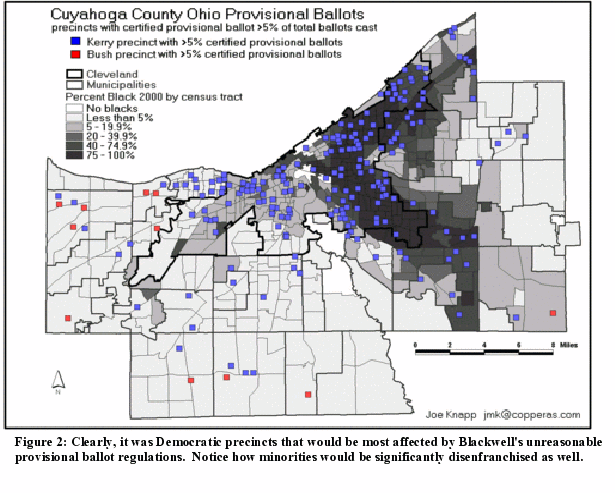
Provisional ballots are special ballots given to voters who say they are registered to vote but whose names don't appear on voter rolls on Election Day. The ballots are separated and reviewed so the registration can be confirmed.59 Minorities (and Democrats in general) were disproportionately more likely to use provisional ballots in this election.
Secretary of State Blackwell and Bush-Cheney '04 Campaign chair issued an order that provisional ballots will be counted only if they are cast at the correct precinct.60 Being full aware of the calculated misinformation campaign in Ohio to tell voters their polling place had changed, Blackwell kept this order in effect.61 This order is even more unreasonable and illogical considering that in Ohio, there were literally two different precincts casting ballots in the same room. If a voter waited in line for two hours, thinking they were at the right table, and they weren't, they would have to fill out a provisional ballot. Under Blackwell's order, that ballot would not be counted because it was filled at the wrong table.
Democratic officials said Blackwell's rule "'turns on its head' a key provision of the Help America Vote Act, the 2002 law passed by Congress after the voting problems in the 2000 presidential election. HAVA encourages provisional ballots as a way to ensure voters aren't wrongly turned away at the polls because their registrations were misplaced or misfiled."62
Blackwell also was widely criticized for ordering that any registration form not printed on 80 lb. paper would be rejected. The ridiculous and obstructionist nature of Blackwell's order was realized by the courts, which overturned it.
Blackwell was not the only Bush-Cheney '04 Chair limited provisional balloting. His actions were echoed by Bush's other Chairs and supporters in other battleground states:
Why does the unreasonable restriction on provisional ballots matter? Well, one professor at Case Western Reserve University, using data from the 2000 election, "calculated conservatively that as many as 13,000 Clevelanders will have to use a provisional ballot as a result of clerical and other errors. The typical discard rate for provisional ballots means that nearly 2,300 of those will be invalidated. But this doesn't include all the people who show up at the wrong polling place and don't get a provisional ballot at all. Multiply this by the eight urban areas around Ohio and the potential for disenfranchisement is high."63
Winning Old School Style: Voter Suppression
"If we do not suppress the Detroit vote, we're going to have a tough time in this election cycle."64
- Republican State representative and Bush-Cheney '04 Michigan campaign chair John Pappageorge
In heavily democratic areas, especially in those voting on punch card ballots, rigging the machines would not, by itself, guarantee a Republican victory. Thus, a nationwide campaign was undertaken to suppress the Democratic vote. From Detroit to Cleveland to Miami, Democratic voters were victims of a premeditated scheme to suppress their votes. Suppressing the minority vote was crucial, since minorities tend to vote Democratic. The 2004 election continued the well-established trend that African Americans were much more likely to vote for Democratic candidates. If the wide-spread intimidation and suppression tactics described below did not exist, would Kerry have won? To place a number on how many people were too afraid to go vote or how many people couldn't wait in line for four or five hours is impossible. But judging from how intense and deliberate and coordinated the suppression was, it is possible that suppression tactics could have overcome Bush's lead in some battleground states.65
There have been reports that efforts to challenge voters were targeted towards blacks, the 'challenge lists' apparently containing an overwhelming percentage of blacks relative to population.66 The challenge lists, used by the Republican party, were distributed to operatives who in turn challenged the right of complete strangers to vote. Those who had their registration challenged were entitled to a hearing. At one such dramatic hearing, the Board threw out 976 such challenges after it became apparent that the people challenging legitimate voters were merely pawns of the Republican party and had no basis for their challenge. Barbara Miller, one such Republican challenger, could be indicted on felony charges because she did not have any personal information about the eligibility of any of the challenged voters, even though she signed a sworn statement that she did.67
Miller said that her challenges were based on a list of "undeliverable mail" given to her by the Republican Party. The list was based on a GOP mailing sent to registered voters throughout the state of Ohio. The Republican party had thousands of voters on its challenge lists, and it is unclear why they would seek to challenge the registration of voters who have lived and voted in Ohio for decades... unless they're Democrats, of course:68
MS. TRIPLETT: My name is Patricia Triplett. I have lived in my precinct for 35 years. A block away I've lived for 20 years, I've lived 15 years. You don't know me, and you brought me up here. We have boys and girls over in another country fighting for someone else's right to vote, and you challenge my right to vote in this country. How sad this is. How sad this is that you're allowed to do that to us. It's just unbelievable and it scares me
MS. McCRANEY: Mr. Lou Wray, you challenged my husband, and we live in the same neighborhood. Okay? But you've never met us a day in our lives, hard-working individuals. My husband is a full-time student at Kent State University, where I also possess a bachelor's degree and a master's degree. We work hard just like you do, trying to make our livings, trying to prove ourselves in this world to get to the point where we're 80 years old, like you.
But you signed your name to 200 documents of people you have never, ever met a day in your life, challenging our right to vote. And you don't even know whether we live… in Tallmadge, Ohio. You have no idea. Somebody just called you on the phone and asked you to do a favor and you said okay.
And now you look foolish standing up here saying, "I don't know. They just called me on the phone. I don't have anything." You look silly. And we have to be inconvenienced and we have to come to work.
MS. HEROLD: I refused mail that was sent to me from the Republican headquarters in Akron. That's the only thing I ever got.
MR. HUTCHINSON: That may be why you were challenged.
MS. HEROLD: But I did not –- it was not undeliverable, it was refused.
MR. HUTCHINSON: I mean, ma'am, I don't know why you were challenged.
MS. HEROLD: I don't, either.
MR. HUTCHINSON: I don't know. But that may be the reason, and it may have come from the Ohio Republican Party and that may have been the reason; I don't know.
It is unclear how many thousands of voters were challenged, how many received reasonable notice of their hearings, how many had to vote provisionally, and whether those votes were counted. What is clear is that the Republican Party knowingly engaged in a campaign meant to deny many long-time residents of Ohio the right to vote.
Confusion & Intimidation To Suppress The Democratic Vote
"We've never seen anything like this before, where there seems to be a concerted effort to give voters misinformation."
- Jane Platten, Cuyahoga County Board of Elections
II.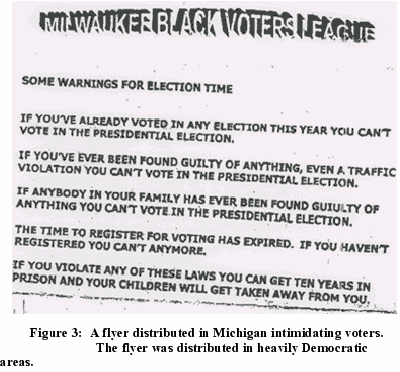 On October 30th, Terry McAuliffe,
chairman of the Democratic National Committee, on national
television, confronted Ed Gillespie, chairman of the Republican
National Committee about voter suppression tactics. McAuliffe said
that 250,000 flyers falsely telling Ohio voters that their
registrations were not valid had been distributed, especially to
minority group voters. By McAuliffe's description, the leaflet was
similar to the forged Board of Elections letter of Oct. 22, sent
out on Lake County Board of Elections letterhead, that told voters
that they were ineligible to vote on Election Day.69
On October 30th, Terry McAuliffe,
chairman of the Democratic National Committee, on national
television, confronted Ed Gillespie, chairman of the Republican
National Committee about voter suppression tactics. McAuliffe said
that 250,000 flyers falsely telling Ohio voters that their
registrations were not valid had been distributed, especially to
minority group voters. By McAuliffe's description, the leaflet was
similar to the forged Board of Elections letter of Oct. 22, sent
out on Lake County Board of Elections letterhead, that told voters
that they were ineligible to vote on Election Day.69
In a sworn affidavit, it was revealed that in Franklin County, Ohio, a worker at the Holiday Inn observed a team of 25 people who called themselves the "Texas Strike Force" using pay phones to make intimidating calls to likely voters, targeting people recently in the prison system. Although the Texas Strike Force website clearly states that lodging shall be paid for by individual members,70 the "Mighty Texas Strike Force" members working in Ohio had their accommodations bankrolled by the Ohio Republican Party.71 The "Mighty Texas Strike Force" was a Victory 2004 group that worked closely with the local GOP.
From their website:72
This band of Texans came as saviors to the locals who had been working for months and were exhausted. They came with new energy, fresh ideas----new blood---fresh meat!
On October 28th the Might[sic] Texans were launched from cities across this great state. Planes were filled with Texans in Bush gear----no shy sunflowers here! They were on a mission and victory was the only acceptable outcome!
Armed with cell phones, and the inspiration of mission, these Mighty Texans worked at non-stop pace walking neighborhoods, making phone calls, organizing and attending rallies-----and when they needed a break----they stood on street corners waving signs and yelling, "For[sic] More Years!"
Meanwhile, back at the nerve center, new ideas developed.
Calls were needed Ohio, Pennsylvania, Michigan, and Florida. Tens of thousands of calls went out from TFRW homes in Texas to those critical states. Calls were still being made election day.
Included in some of those calls made by the "Mighty Texas Strike Force" were calls made from public pay phones that threatened and intimidated voters. Evidence shows that a hotel worker at the Holiday Inn heard a Texas Strike Force caller threaten a likely voter with being reported to the FBI and returning to jail if he voted.73 The calls were apparently being made to former felons who had their right to vote restored upon completion of their sentence. The calls made threatened these people that if they showed up to vote, they would be arrested.74 Another hotel worker called the police, who came but did nothing.
These calls constitute a clear felony violation of the Voting Rights Act, punishable by up to five years in prison.
Election Day Stand Down: Tire Them Out, Frustrate Them, Scare Them, And Make Them Leave
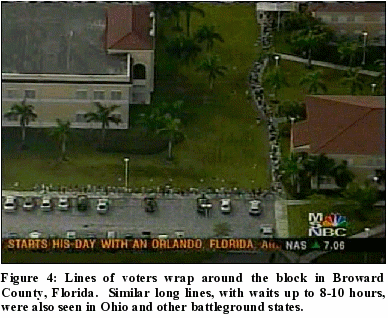
Sources close to the Board of Elections told the Free Press that Matthew Damschroder, Chair of the Franklin County Board of Elections, and Ohio's Secretary of State Kenneth Blackwell met with President Bush in Columbus on Election Day. The idea was to discourage turnout in Democratic wards by forcing voters to wait in long lines at the polling places.75
And did they wait. There were reports of voters casting their ballots at 2 a.m. on November 3rd, after waiting in line for over 10 hours.
In battleground states, especially in Ohio and in Florida, there were lines of hundreds and hundreds of voters. Was this result of unprecedented turnout? Or was there a more suspicious cause? Despite long lines, Ohio voter turnout was not record breaking.76
Discriminatory Machine Allocation & Ohio's New Poll Tax
The long lines most affected those who could not afford to wait so many hours to vote. Essentially, it came down to "wait in line for hours and miss work and pay" or "go to work, and don't vote." A disturbing number of Ohioans had to make this choice. And according to one Ohio judge, waiting in an excruciatingly lone line and being forced to make that choice "imposes an undue burden on the right to vote and in effect could amount to a denial of that right."77
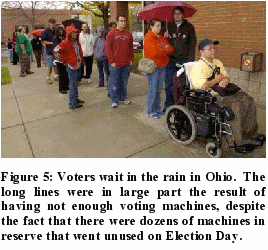
A calculated distribution of voting machines caused severe shortages of voting machines in primarily Democratic areas, which in turn caused a backlog of voters who had to wait hours in the pouring rain to cast their votes. Videos of such voter suppression can be viewed at The Free Speech Zone here: http://www.thefreespeechzone.net/ . The images in those videos are disturbing and infuriating. What they show is that voting machine allocation in Ohio had a racially discriminatory impact, and that there is absolutely no question that the decision to distribute fewer machines to Democratic areas affected the vote in Ohio.
The Board of Elections' own document records that, while voters waited in lines ranging from 2-7 hours at polling places, at least 68 electronic voting machines remained in storage and were never used on Election Day.78
Jeff Graessle, Franklin County Election Operations Division Manager, says they allocated their machines based on a new criteria determined by active registered voters.79 However, the actual allocation of machines seemed been based 2000 levels, essentially "capping" Democratic turnout to four years ago, despite huge registration drives and interest in the election.80 Moreover, Graessle's excuse doesn't hold any water, because it would require that Democratic precincts had less active voters 85% of the time.81
 Nearly
one out of three (31%) Democratic precincts had less voting
machines in 2004 than in 2000 compared to less than one out of six
(16%) Republican precincts. Looking at it a different way, of the
217 precincts where voting machines were subtracted, 184 (85%) were
Democratic.82
Nearly
one out of three (31%) Democratic precincts had less voting
machines in 2004 than in 2000 compared to less than one out of six
(16%) Republican precincts. Looking at it a different way, of the
217 precincts where voting machines were subtracted, 184 (85%) were
Democratic.82
Why was this "new criteria" of rewarding "active registered voters" implemented when Ohio officials knew full well that there would be an huge increase of new (and thus previously inactive) voters throughout the state, and especially in urban, Democratic areas? As one professor said: "in Franklin County, Ohio's formula served to disenfranchise disproportionately poor, minority and Democratic voters under the guise of rewarding the 'likely' voter or active registered voters."83
The decision to cut back on machines in Democratic areas was a calculated attempt to cause overcrowding and to limit the number of votes cast for Kerry. In the most heavily Democratic precincts (80 to 100%), nearly three out of four precincts (74%) ended up extremely crowded after voting machines were subtracted. Most of these latter precincts are majority African-American, if voting patterns were similar in Franklin County to the rest of the country.
"One can estimate that a majority African-American precinct was 12 times more likely than a Republican precinct to have voting machines taken away in 2004 and end up being extremely crowded. On the other hand, of the seven heavily Republican precincts where voting machines were subtracted, four were still not crowded (less than 205 voters per machine). Only 4 of the 77 precincts that were extremely crowded on election day due to voting machines being subtracted were Republican."84
How do we know the decision to allocate fewer machines in Democratic areas cost Kerry votes?
In precincts where there was no change in the number of machines, heavily Democratic precincts were again much more likely to be extremely crowded - 20 percent of very Democratic precincts (80 to 100% Democratic) and 16 percent of precincts that were 60 to 80% Democratic. This compares to only 6 percent of precincts that were moderately Republican (50 to 60%) and 3 percent of precincts that were heavily Republican (60 to 80%).85
For all the talk of Bush winning the GOTV in Ohio, the fact remains that more Democrats showed up to vote than Republicans -- the Republicans just got to vote because they had the machines.
Let's take a closer look at Franklin County. Overall, 19 percent of Franklin County precincts were extremely crowded on election day. But Democratic precincts were two and a half times more likely to be extremely crowded than Republican precincts. "Of the 136 precincts that had at least 80 percent Democratic registration, only 16 percent were not crowded while 38 percent were extremely crowded. As mentioned before, these are likely majority African-American precincts. On the other hand, of the 45 heavily Republican precincts, 44 percent were not crowded and only 7 percent were extremely crowded. The likely African-American precincts were over five times more likely than the heavily Republican precincts to be extremely crowded on November 2. A very conservative estimate is that over 22,000 voters in Franklin County alone were denied the right to vote because of the voting machine allocation.86
Damschroder, former head of the Franklin County Republican Party admitted that he had not asked the Franklin County Commissioners for any additional money this year for new machines, despite a 24% increase in voter registration.87
There were "frantic requests" on Election Day from poll workers begging for more machines. But the new machines sat in the warehouse and were not deployed. According to the Columbus Dispatch, "Damschroder's office received 32 calls from precinct judges requesting more machines, not one of which was filled. Only nine of those calls came from suburban precincts, while 23 came from the Inner City."88
Bully Tactics, Deceit, and Other Efforts To Suppress Votes At The Polling Place
"Every election cycle, you hear after the fact about the white sheriffs who sat there for five hour with guns holstered who are there to intimidate. They're there to shave 1 percent off. With all this voter registration activity going on, some people don't want those people to vote."
-Mike Casey, Citizens Against Un-American
Voter Intimidation (Ohio)89
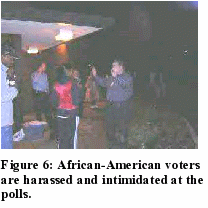 At 7:05 p.m., 25 minutes before polls closed in Toledo,
Ohio, "white, Republican challengers were witnessed harassing
voters at the Mott Library Central City polling station, a
low-income African-American community. Observers said that they
believed these challengers had been repeatedly calling the police
producing absurd stories in order to intimidate voters. One of the
Republican challengers was recognized as Dennis Lange, a prominent
white business owner who owns Pumpernickels. Mr. Lange aggressively
tried to push back African-American community members who were
poll-watching and voting at the site. At one point more than four
police officers, including undercover officers, were witnessed at
the site for no reason."90
At 7:05 p.m., 25 minutes before polls closed in Toledo,
Ohio, "white, Republican challengers were witnessed harassing
voters at the Mott Library Central City polling station, a
low-income African-American community. Observers said that they
believed these challengers had been repeatedly calling the police
producing absurd stories in order to intimidate voters. One of the
Republican challengers was recognized as Dennis Lange, a prominent
white business owner who owns Pumpernickels. Mr. Lange aggressively
tried to push back African-American community members who were
poll-watching and voting at the site. At one point more than four
police officers, including undercover officers, were witnessed at
the site for no reason."90
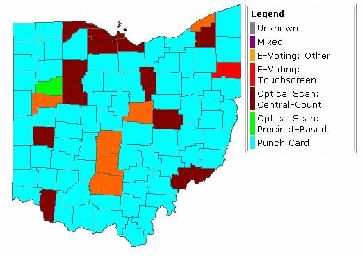
I submit that the strategy undertaken in Ohio was a bifurcated attempt to both pad the Republican totals in areas utilizing electronic voting and to prevent traditionally Democratic voters from casting their ballots in paper ballot precincts. As will be demonstrated below, the most heavy and severe voter suppression occurred in traditionally Democratic areas. The heaviest occurred in Democratic, paper-ballot casting counties. This trend occurred not only in Ohio. The same systematic, calculated attempts to suppress the Democratic vote can be seen in many other states, battleground and non-battleground alike (See Appendix A).
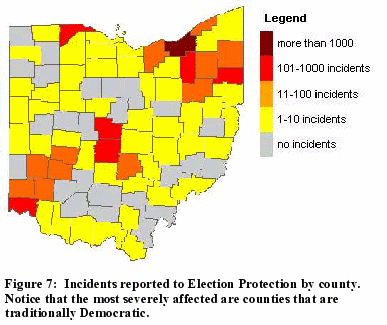
Most severe obstruction was in blue states. There are currently 3,409 incidents reported through one agency for the state of Ohio.91 Every incident reported affects many voters, perhaps hundreds of them. The highest number of incidents were reported in the Democratic counties of Cuyahoga (1,249 incidents), Franklin, Mahoning, Summit, and Delaware. Incidents reported in Cuyahoga county, which Kerry won, accounted for over 1/3 of all incidents reported for the entire state. The incidents reported through Election Protection included misinformation, deception, misconduct on the part of election officials, and intimidation on the part of Republican challengers. Below are some of the most prevalent complaints:
 A voter asked for a provisional ballot and was
denied one. Official reported that others in this 80 percent
Democratic, heavily minority precinct are having the same
experience.
A voter asked for a provisional ballot and was
denied one. Official reported that others in this 80 percent
Democratic, heavily minority precinct are having the same
experience.The above incidents occurred not just in Ohio, but were echoed throughout the nation. In New Mexico, for example, DNC workers were approached by Republican operatives asking they serve as "bouncers" at the polls to scare minorities away.92 It is impossible to estimate how many voters -- and Democratic ones at that -- were intimidated and did not cast their votes.
Counting -- And Discounting -- The Votes
"It's not the voting that's democracy, it's the counting."
Tom Stoppard, Jumpers (1972) act 1
When the votes started coming in, there were red flags raised. First, the vote totals did not match up with the exit polls (we'll touch on that later). Second, vote totals posted on the Secretary of State's website just weren't adding up.
Fuzzy Math and Ohio Irregularities
Ballot Spoilage: Throwing away legitimate votes?
Across the state on Nov. 2, counties that used punch-card voting, as Montgomery County did, had a higher rate of undercounted ballots than counties that used optical scanning technology or electronic voting machines, which had the lowest undercount.
Two precincts -- one in Kettering and another in Washington Twp. -- had undercounts of more than 25 percent.102 Both Kettering and Washington Township are in Montgomery County, where Kerry won 51% to Bush's 49%. One in four people in those precincts decided not to vote? That is highly unlikely. How else can an undervote be made with punch cards? With punch cards, undercounts can occur when a voter:103
At a hearing conducted on Ohio irregularities, a voter testified that in Trumbull County, they received punch-card ballots where holes were already punched for Bush.104 If a voter did not notice this, and went to vote for Kerry, their vote would be not counted since more than one candidate was selected. When they walk out of the polling place, they would inform the exit pollster they voted for Kerry, not knowing their ballot is double-voted and would not count.
What about the "hanging chad"? It is estimated that at least 93,000 spoiled votes, overwhelming Democratic ones, were not counted in Ohio's election because of problems with the punch card. In Florida in 2000, federal investigators determined that black voters' ballots spoiled 900% more often than white voters, mainly due to punch card error. Sadly, from the chart below, we see the same effect in Ohio; those disenfranchised because the chad didn't fall off completely or for some other punch-card reason are mostly African-American, and overwhelmingly Democratic.
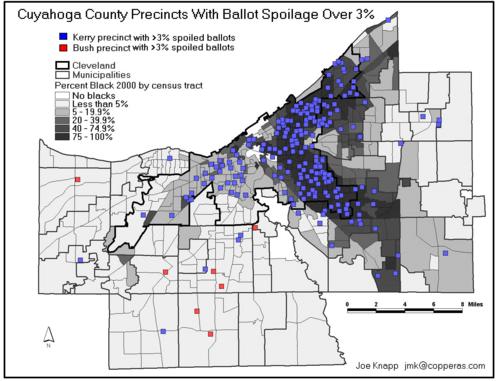
Figure 3: Ballot spoilage occurred primarily in Democratic areas. Some counties had spoilage as high as almost 8% while some precincts reported spoilage of 25%.
Things That Make You Go "Hmmmm"
Those who watched the media coverage on November 2, 2004 know that something went horribly wrong. Throughout the day, exit poll numbers "leaked" on the internet showed Kerry with a decisive lead early in the morning, which tapered off to a solid 1%-3% lead in many battleground states. While early exit polls are, because of their incompleteness, notoriously inaccurate,105 the fact that exit polls still showed a Kerry lead late into the night has been a point of concern for many. It was because the exit polls were conflicting with the actual results late into the night that the networks were so late in calling many states. The next morning, Bush was declared the winner, and the exit polls, as Charles Gibson reported, "were dead wrong."
Why focus on the irregularities in the exit polls? Why not just trust the votes? Some say they have been inconsistent,106 others say that have been close to 2% accurate traditionally.107 In a normal, healthy democracy, we could trust the actual vote totals. In a world where our voting system isn't privatized by partisan officials, where the technology used to count the votes isn't ridiculously hackable, and where those in charge of the process aren't blatantly and aggressively partisan, then of course we could trust the actual vote. But we are not living in a healthy democracy. And as the various experts studying the exit polls have suggested, it is nearly impossible the exit polls were "dead wrong." As you read below, keep in mind the voter suppression tactics detailed above. It is the totality of the circumstances here that supports the theory of coordinated attempts to influence the vote.
" Exit polls are almost never wrong... This was no mere mistake. Exit polls cannot be as wrong across the board as they were on election night... I suspect foul play."
- Fox News Pundit and Republican Strategist Dick Morris108
Dick Morris is not a liberal. He didn't vote for Kerry. Indeed, he thinks the exit poll discrepancy is some liberal conspiracy (we'll address this later).
It is easy -- too easy -- to simply say "exit polls are garbage". Such a statement is both uninformed and reckless. Exit polls have been reliable enough that they are used to judge the legitimacy of elections around the world. As recently as a few weeks ago, it was the (U.S. conducted) exit polls in part that led to the overturning of a fraudulent Ukrainian election. Exit polling isn't just asking people to raise their hands; it is a highly sophisticated art which has consistently been improving. The NEP (National Election Pool) states that there was only one mistake made from 1990 - 1998. After 2000, there were major adjustments made to increase reliability: "NEP will conduct exit polling in more voter precincts and have access to a greater number of past vote counts to use on a comparison basis... 'The things that clearly went wrong four years ago, it's hard to imagine them going wrong again with what they've done with this system.'"109 That being said, we must acknowledge that although exit polls are usually used by networks to project winners before all the actual votes are counted, they are primarily valuable because of the demographic data they provide.110
Why has there been so much controversy over the exit polls in this election? Simply put, the exit polls on Nov. 2 and the final polls released on the Nov. 3 are dramatically different, and some believe that the discrepancy between the two is suspicious and suggestive of fraud. Adding to the concern is that the same early exit polls were accurate for many tight Senate races, while the presidential exit polls were "proved wrong".111
Traditionally, exit polls are conducted until about 6 p.m.112 But four hours after the polls closed, the exit poll numbers were still changing, and they were doing so in mathematically impossible ways.
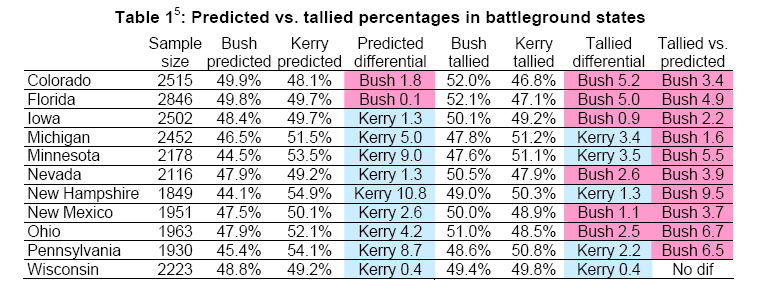
Figure 4: "Red shift"
The Ohio and Florida were not the only battleground states with a noticeable "red shift."115 The apparent discrepancies illustrated in the table above have been subject to increased scrutiny my statisticians and academics:
The entire controversy, then, is, if we assume the early, weighted exit polls were correct, is why were the polls so consistently outside the margin of error? Why did the later night polls, showing Kerry ahead, differ so greatly from those released the next day, showing Bush in the lead? How did a 180 degree reversal in fortune occur between 7 PM and 1 AM, when CNN "fixed" its exit poll numbers on its website? Mysteriously, the Mitofsky server crashed. Why did the system crash? The machines used were not 12-year-old IBM dinosaurs. They were state-of-the-art machines which underwent rigorous testing for months and months prior to November 2:121
The consortium has reportedly spent $10 million on a new computer system. It performed well during 23 primaries this year and has handled weekly "stress tests" that continued through this weekend, Lenski says. During such tests, software programs generate amounts of information equal to or greater than what the computers will be receiving on Election Day. In some tests, Lenski says, 12 hours' worth of data were pushed through the system in three hours. "The rehearsals have gone very well," he says.
Yet shortly before 11 p.m. on November 2, this system that performed so successfully in so many stress tests mysteriously crashed. The "glitch" prevented access to any exit poll results until technicians got a backup system operational at 1:33 a.m. on November 3rd. When the servers came back online, Kerry's three point lead he had was gone, and Bush had pulled ahead.122 The final vote totals were "corrected" to adjust to the actual votes, because they thought the exit polls were wrong. Let's look at some theories offered for why they might have been so wrong:
1. The exit polls were wrong because they over sampled women, who tend to vote for Kerry.
The composition of the national sample by gender was 46% male, 54% female. Let's assume for argument's sake that the results were skewed towards Kerry. Does reweighing the sample to reflect a “normal†gender breakdown of 52% female, 48% male still give Bush the win? Reweighing the sample to appease the "women vote for Kerry" contenders increases Bush’s exit poll percentage by0.2% to 48.4% and decrease Kerry’s to 50.6%. The effect on the bottom line is minimal: Kerry would be the popular vote victor 96.9% of the time.123
2. The exit polls were wrong because Bush supporters were reluctant to answer.
Were Bush voters, for some reason, more likely to brush off exit pollsters? There has not been a scintilla of evidence to support this argument.124 Mitofsky thinks that is what happened, but he himself states "I can't prove it." 125Furthermore, why would Bush supporters in say, in Illinois, where the exit polls matched, be more likely to talk to exit pollsters than Bush supporters in Ohio?
William Kaminsky, a graduate student at MIT. Kaminsky finds that in 22 of the 23 states which break down their voter registrations by party ID the ratio of registered Republicans to registered Democrats in the final, adjusted exit poll was larger than the ratio of registered Republicans to registered Democrats on the official registration rolls. In other words, the adjustments performed on the exit polls in order to get them to agree with the official tallies would, if valid, require Republicans to have won the get-out-the-vote battle in essentially every state.126(emphasis mine).
3. The exit polls were slanted to Kerry as part of the liberal media's conspiracy to suppress Bush's turnout.
This is what Republican Dick Morris argued (above) when he said "there was foul play.." But a "complete analysis of all 45 states and the District of Columbia for which comparable exit poll data is available shows that four out of the 11 battleground states had exit poll/vote count discrepancies that were outside of a standard 5% (one-tail) margin of error, whereas this was the case for only one of the 35 nonbattleground states. Moreover, all of these statistically significant discrepancies were in favor of Bush. This data is at odds with claims of "systemic" procedure-Kerry exit poll skew."127
There was a surge of Bush supporters after 4 PM.
In all states? This argument is faulty on many grounds. Skeptics say that more Bush supporters work, so they would vote after their jobs, whereas many Kerry supporters are unemployed and voted earlier in the day. But what about the thousands of Kerry supporters who were in line well into the night? Indeed, as was explained above in the allocation of machines section, Kerry voters were more likely than Bush supporters to be waiting in line well into the night.
 But... Bush Won The Popular
Vote!
But... Bush Won The Popular
Vote!
Ah, yes, Bush's "mandate." Until we see the raw data, we will have to work with the assumption that the exit poll data pre-server crash were largely correct (and seeking as we've debunked several myths to the contrary, that seems to be a permissible assumption for the purposes of our argument.)
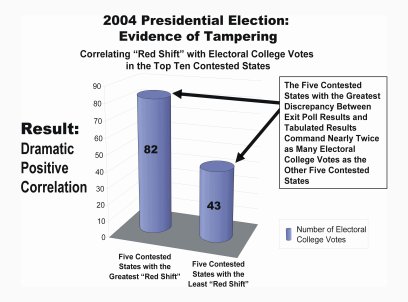
Figure 5: More questions. Could such red shift correlation be explained away by the raw exit poll data?
A recent paper, working with the CNN numbers--assuming proper poll methodology, no discriminatory suppression, and an accurate and honest popular vote count--finds that the probability Kerry would have received his reported popular vote total of 48.1%, or less is one in 959,000--a virtual statistical impossibility.128"Put another way--given the exit poll results, proper poll methodology, and an accurate and fair voting process -- Kerry would be the popular vote winner of Election 2004 98.7% of the time."
More Questions Than Answers
What is clear from all the number-crunching and analysis is that there are more questions than answers about the exit polls at this point. The curse of statistics, it is said, is that they can never prove something, but only disprove it.
Many of the questions about the accuracy of the exit polls, the relationship of the polls to the actual vote totals could quickly be answered by accessing the raw, precinct-level data.129. There is an army of both statisticians and academics on both sides of the issue which would objectively analyze the data and come to a final, clear determination of what, if anything, went wrong with the exit polls (both the early numbers and the final ones). But, despite the immense public interest in accessing this data, the NEP which owns the data has consistently refused to release the data. The burden of proof should shift to those in control of the machines and the party officials involved to disprove the likelihood of tampering.
Let the Recounting Begin
"People in other States talk about the unbelievable burden of recounts. They do not realize the costs of restoring legitimacy is far greater than the costs of maintaining it.'"
- Secretary of State of New Hampshire
Because of the disturbing exit poll discrepancies--which can only be explained through systematic error (unlikely) or fraud (possible), it was not surprising that many wanted an investigation of the actual vote count. While there were several battleground states which were narrow victories for Bush or Kerry, David Cobb of the Green Party and the Libertarian Candidate filed for a recount in Ohio. Why Ohio? Because, as an Ohio judge so eloquently put it: the Ohio Republican Secretary of State has been so uncooperative that he "apparently seeks to accomplish the same result in Ohio in 2004 that occurred in Florida in 2000."130
Under Ohio law, a recount or a contest election cannot be made until the Secretary of State makes the final vote totals "official." Blackwell did not approve the vote totals until December 6th, 2004, six weeks after the election. For perspective: During that same time frame, Washington state approved its results, had a recount, and began a second recount of the ballots.
A proper recount in Ohio would serve to quell suspicions about the legitimacy of the vote there. If, in the recount, the law was followed, the information was open to the public to see, and the votes were all counted properly, we would assume that the actual total would be verified.
Instead, what has transpired in Ohio over the last months evidences a deliberate attempt to hide or deny access to critical data, tampering with voting machines, stonewalling, and law-breaking... all of which beg the question... "What is Secretary of State Blackwell hiding?"
Ohio's official recount procedures mandate the following:131
Boards of Elections must notify all candidates in the race of the time and place by certified mail not later than five days before an automatic or requested recount is held.
Each candidate in the race is entitled to one witness for each counting team or tabulating unit.
The board must randomly select whole precincts whose total equals at least 3% of the total vote. These precincts' ballots must be manually counted.
If the computer count does not match the hand count, and after rechecking the manual count, the results are still not equal, all ballots must be hand counted.
As described below, the precincts selected for an "audit" were not randomly selected, Triad technicians tampered with tabulation machines during the recount, and vote totals failed to match up; all of these cast doubt over the legitimacy of the original Ohio vote count.
Coshocton County apparently performed a "recount" on 12-10-2004, 4 days in advance of the time scheduled for the "official" recount, without issuing the required notice or permitting authorized witnesses to attend; and apparently "found" 1,077 more valid votes than they had certified 4 days earlier.132
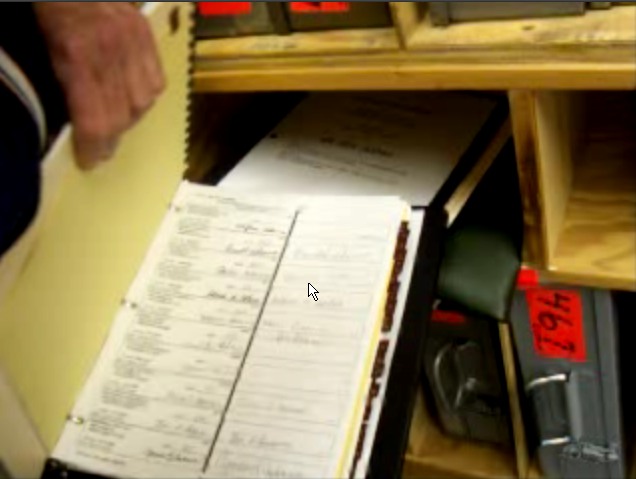 In Green County, two election observers were researching
voting records for the recount when the poll books were taken from
them, under direction of Blackwell, who declared a "lockdown" on
all voter records during the recount.133 But later that night, the Green County
offices were discovered unlocked, with unfettered access to ballots
and voter records. Green County officials said
"voter records are kept in a separate locked
room, and had not been tampered with."134 Yet as the
picture to the right clearly illustrates, those who discovered the
offices open and called the police discovered the poll books, in an
open room, with no security.135
In Green County, two election observers were researching
voting records for the recount when the poll books were taken from
them, under direction of Blackwell, who declared a "lockdown" on
all voter records during the recount.133 But later that night, the Green County
offices were discovered unlocked, with unfettered access to ballots
and voter records. Green County officials said
"voter records are kept in a separate locked
room, and had not been tampered with."134 Yet as the
picture to the right clearly illustrates, those who discovered the
offices open and called the police discovered the poll books, in an
open room, with no security.135
In Washington County, in addition to other irregularities, the recount in this county appears to have "lost" even more votes than Coshocton County "found".136 Blackwell certified the following totals (SoS web site):
Badnarik 71
Bush 17,480
Kerry 12,475
Peroutka 69
The totals printed out and given to the recount observers as the final, complete tally:137
Badnarik 68
Bush 15521
Kerry 10958
Peroutka 60
So, somewhere between the certification on Dec 6 and the recount on Dec 15, Washington County lost at least 3,488 votes. No explanation has been given for this discrepancy.
There were at lease six (6) instances of confirmed tampering with tabulating machines:
Hocking County138 (Triad technician)
Greene County139 (Triad technician)
Monroe County140 (Triad technician)
Mercer County141 (Triad technician)
Lucas County142 (Diebold technician)
Union County143 (Triad
technician)
There were at least seventeen (17) violations of Ohio law, where the selection of the "3%" to be recounted was not random, as required by law, but pre-selected or was selected for a specific criterion:
Monroe County144
Mercer County145
Allen County146
Fayette County147
Cuyahoga County148
Huron County149
Lucas County150
Morgan County151
Morrow County152
Medina County153
Fairfield County154
Clermont County155
Washington County156
Hocking County157
Mahoning County158
Holmes County159
Jefferson County160
In at least six (6) counties, Ohio law was violated when there was a discrepancy between the 3% hand count and machine recount, but the Board of Elections refused to conduct an full-county recount:
Monroe County161 (Kerry 55%, Bush 44%)
Tuscarawas County162 (Bush 56%, Kerry 44%)
Fairfield County163 (Bush 63%, Kerry 37%)
Clermont County164 (Bush 71, Kerry 29)
Summit County165 (Kerry 57%, Bush 43%)
Mahoning
County166 (Kerry 63%, Bush
37%)
Possible failure to do mandatory full recount:
Lucas County167 (Kerry 60% Bush 40%).
Scheme to avoid discovery of actual totals: When the hand count would not match the machine count, instead of hand counting the entire county as required by law, the Board of Elections just changed the machines.168 Apparently, it is Triad's belief that "the machine is always right". 169
Needless to say, this non-recount netted few new votes for Kerry.170 While the recount was going on, some startling facts came to light:
Triad had remote access to the voting machines during the elections.171
Triad left unofficial vote totals on public servers, where the vote totals could be accessed by anyone.172
Triad is alleged to have came into Hocking County, put a "patch " on a voting tabulator,173 and instruct the workers on how to put up a "cheat sheet"174 to ensure that the hand count matches the machine count. A Triad employee was caught on tape, admitting to the same.175
Prima facie fraud: The Ohio Revised Code Title XXXV, Elections, Sec. 3503.26, requires all election records to be made available for public inspection and copying. Under Ohio law, it is a crime for any employee of the Board of Elections to knowingly prevent or prohibit any person from inspecting the public records filed in the office of the Board of Elections. Sec. 3599.42 clearly states: 'A violation of any provision of Title XXXV (35) of the Revised Code constitutes a prima facie case of election fraud within the purview of such Title.
During the recount, while workers were examining poll books for discrepancies, Blackwell issued a surprise order making all voter records for the state of Ohio private; they were no longer considered "public records" or available for inspection.
These wilful violations of Ohio law during the recount process would raise a reasonable suspicion that deliberate restriction to ballots and records is an attempt to cover something up. Whether that "something" is fraud or incompetence can only be determined by a full investigation into the matter. Suffice it to say, the Ohio "recount" has not been conducted in a manner which would lend any weight to the accuracy of the initial results.
The Conyers Brigade
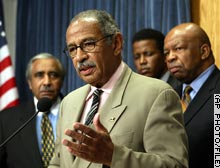
Figure 6: Conyers is leading the Ohio investigation.
Congressman Conyers, a Democrat from Michigan, has spearheaded an effort to investigate the Ohio "irregularities" when everyone else, and the media, have turned a blind eye. Along with Representative Jesse Jackson, Jr., Reverend Jesse Jackson, and the Democratic Members of the House Judiciary Committee, Conyers conducted a series of hearings in Washington and in Ohio. What was revealed at these hearing was "jaw-dropping." From voter testimonials, to testimony about vote rigging software, to testimony about manipulating the vote, the hearings proved that, contrary to Blackwell's assertions, the Ohio election was not "tremendously successful."176
Congressman Conyers sent Blackwell a letter, detailing the irregularities and asking for a response.177 Instead of answering the questions, Blackwell claimed that only the General Accounting Office had the authority to compel him to answer, and that answers to Conyers' questions were readily available from the media. This obviously was not true. Conyers replied, respectfully asking Blackwell to cooperate. Not surprisingly, Blackwell has not answered the questions, and in typical Blackwell fashion, he has taken any and all steps to insulate himself from investigation.
Because of what was revealed at the hearings, Conyers will be contesting the approval of Ohio's electors on January 6th.178 He sent a letter to all 100 Senators asking them to object as well. The signature of both a Representative and a Senator are required for an objection to be valid. In the meantime, Conyers has asked that the networks release the raw data so that the exit polls and actual vote totals may be analyzed appropriately.179
Keeping The Cards Close: Networks Refuse
To Release Raw Exit Poll Data
"We're not talking about proprietary trade secrets, or a "secret source" that they're trying to protect. We're talking about information about us, the American people who voted on Election Day. It's like having your doctor refuse to let you see your own medical records."
-Gary Beckwith180
Despite pressure to release the controversial raw data, the exit poll firm and the media have refused to release the information.181 Claiming they are still "evaluating" the data, the media has rejected Congressman's Conyers' request that they make the data available. Conyers assured the networks he would honor any and all requests they may have concerning the proprietary nature of the methods used and other confidentiality interests, but the networks still refuse to promptly disclose the raw data. Failure to release the data results in a reasonable suspicion that there is something suspicious about the raw data.
A release of such data would either quell suspicions of exit poll rigging, or it would confirm that the exit polls were fixed. Either way, the fact that the media can keep such critical information private when there are such important interests at stake is disturbing. Such a game of "hide-and-seek" has no place in an open and transparent democracy.
The National Council On Public Polls (NCPP) is an association of polling organizations established in 1969. Its mission is "to set the highest professional standards for public opinion pollsters, and to advance the understanding, among politicians, the media and general public, of how polls are conducted and how to interpret poll results."182 Warren Mitofsky, who conducted this year's exit polls, is a Trustee of the NCPP.183 The NCPP has its own Principles of Disclosure:184
We, the member organization of the National Council on Public Polls, hereby affirm our commitment to standards of disclosure designed to insure that consumers of survey results that enter the public domain have an adequate basis for judging the reliability and validity of the results reported.
It shall not be the purpose of this Code to pass judgment on the merits of methods employed in specific surveys. Rather, it shall be our sole purpose to insure that pertinent information is disclosed concerning methods that were used so that consumers of surveys may assess studies for themselves. [...]
It is reasonable to require disclosure of pertinent information regarding methods when questions are raised about survey results or how a survey has been conducted. The purpose of such disclosure will be to insure that adequate information is available, not to evaluate the specific techniques that were employed.
Trying To Litigate For Truth
Ohio attorney Cliff Arnebeck, with other lawyers, filed an Election Contest in the Ohio Supreme Court, claiming that widespread fraud/errors occurred and that Kerry is the legitimate winner of Ohio, and by extension, the Presidency. Arnebeck focuses on the seemingly unexplainable exit poll discrepancies, along with traditional ballot-stuffing and fraud, to make his claim. One aspect of his case involved the race for Ohio Supreme Court Chief Justice. Ellen Connally received thousands of more votes than Kerry, who was at the top of the ticket. Her opponent, who won, was Republican Chief Justice Moyer.
Litigation with respect to the 2004 election has been stalled, plagued by technicalities and questionable tactics and rulings. The reality is that there is no way to resolve the issue prior to the approval electors, or even prior to Bush's inauguration. Thus, while Arnebeck's lawsuit seeks to overturn the election, the reality is that its journey through the judicial proves will examine flaws in the 2004 election, rather than put Kerry in the White House.
A Choice
A small team of international election monitors from the Organization for Security and Co-operation in Europe (OSCE) were invited to monitor the election. The OSCE observers were granted access to polling stations in a number of states, however sometimes only in specific counties. They have released a preliminary statement:187
"International monitors at a polling station in southern Florida said Tuesday that voting procedures fell short in many ways of the best global practices. The observers said they had less access to polls than in Kazakhstan, that the electronic voting had fewer fail-safes than in Venezuela, that the ballots were not so simple as in the Republic of Georgia and that no other country had such a complex national election system. Two-member observer teams fanned out across 11 states and included citizens of 36 countries, ranging from Canada and Switzerland to Latvia, Kyrgyzstan, Slovenia and Belarus."
America should be leading the world in the way we conduct our elections. As exporters of the American Brand of Democracy®, we should not settle for a dangerously flawed democratic process.
There are those that will look at the facts presented here and think "Well, that happens in every election, so what?" But the fact that such tactics of suppression and manipulation have been accepted as legitimate proves that America's very democracy is at risk. And the overarching question is this: Out of all the "irregularities" detailed in this paper and in the investigation of Ohio, why have all of them favored Bush? If they were due to chance or error, should it have not been a 50-50% chance that Kerry would benefit from them as well?
What we have seen in Ohio and throughout the nation in this election, indeed over the last few elections, is the erosion of the 15th Amendment. We have seen public officials serving private interests. We have gross abuses of power across the board, votes vanish into thin air, and the totality of the circumstances suggests that fraud is a very real possibility.
119,000 votes. That is the margin of victory in Ohio. That number does not seem that large in light of how many thousands upon thousands were systematically removed from voter rolls, were unreasonably challenged, were intimidated, were told that Democrats vote on the 3rd... it's not such an insurmountable number when you think of all the testimony of "vote-hopping," of pre-punched cards, of long lines.
What happened in Ohio happened in every battleground state. There are fundamental unanswered questions, which must be answered before we so quickly declare that the 2004 election went off without a hitch. We have a clear choice: accept the dangerous and unjust status quo, or act immediately for investigation and reform.
The warning alarm has reached a fever pitch; something is terribly wrong with our electoral system, and unless we do something immediately, there will not be any legitimacy left in our election. If we do not address these issues now, 2008 will bring more aggressive intimidation, more vulnerable software, more tried-and-true methods of shaving off or padding votes, more stonewalling and hiding the truth.
The next vote that will be stolen may be yours.
Now what are you going to do about it?
--georgia10
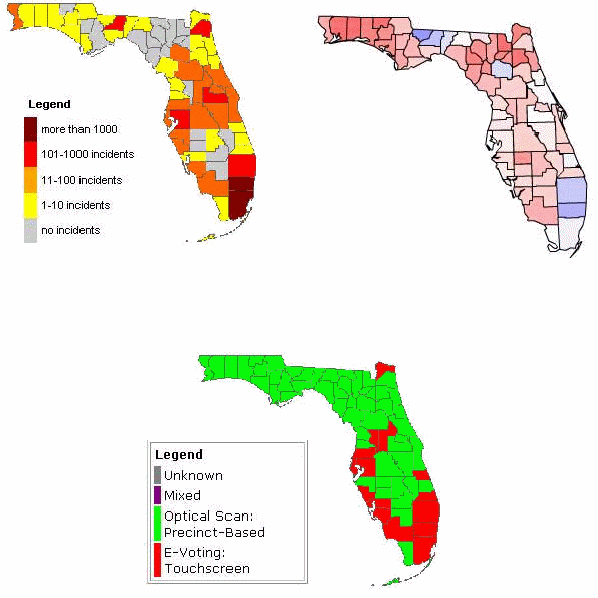
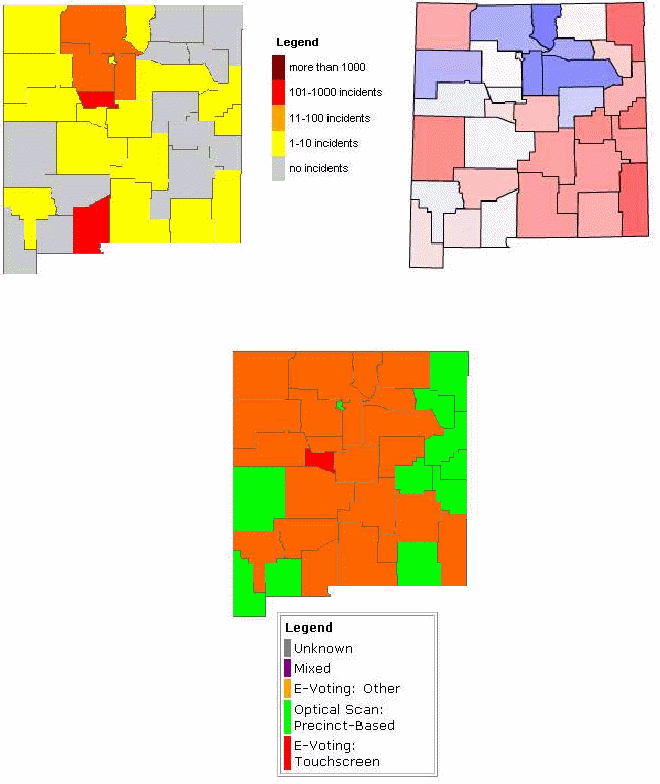
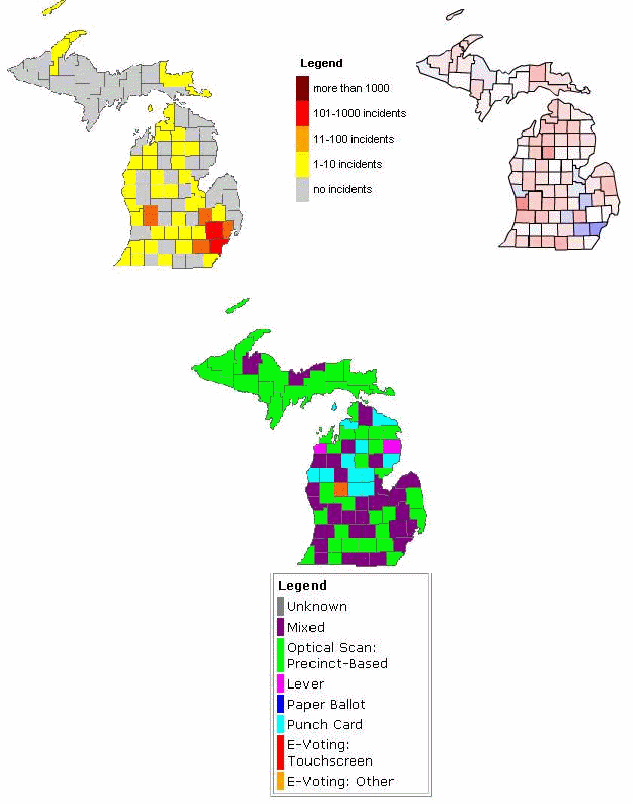
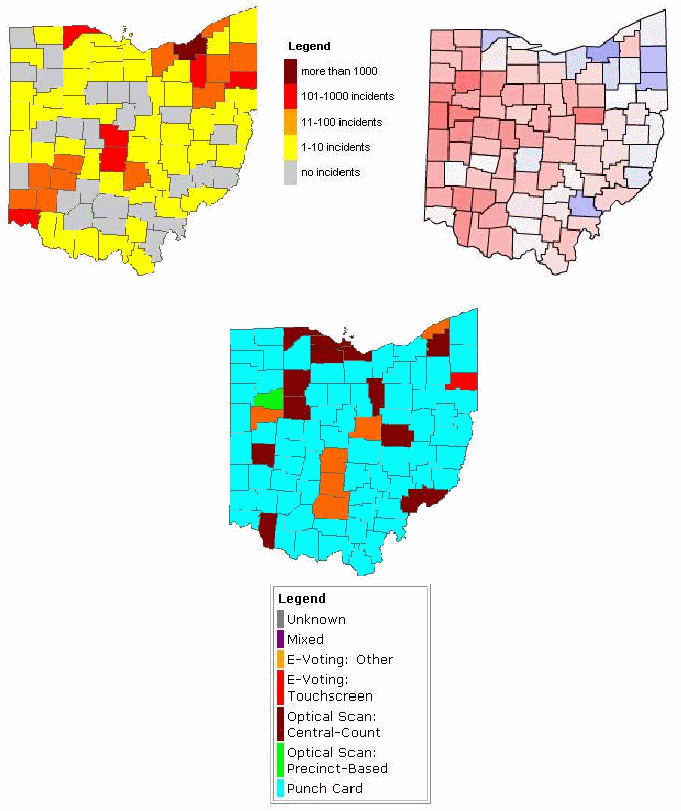
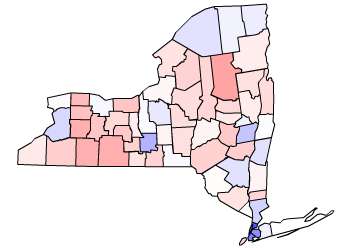
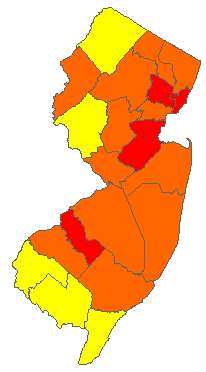
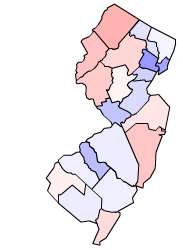
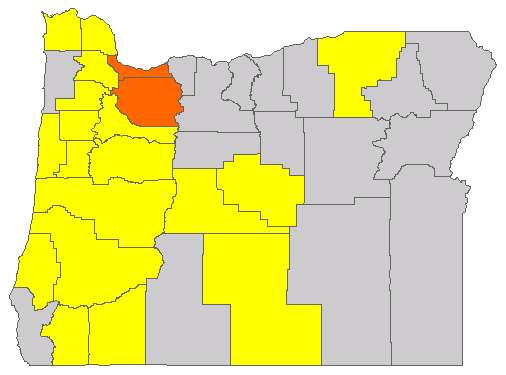
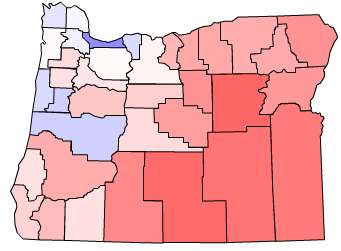
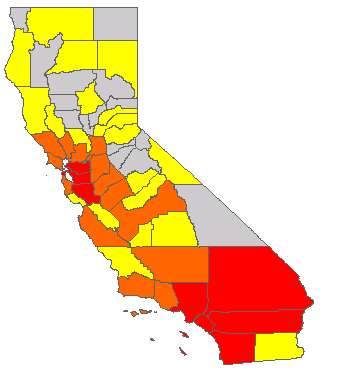
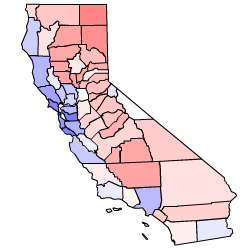
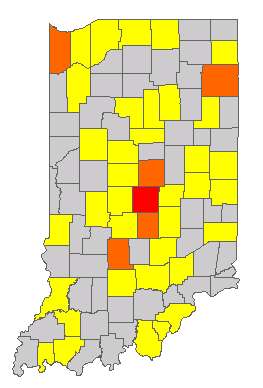
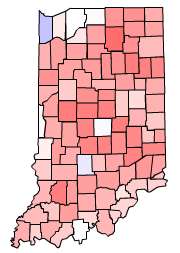
The following maps of incidents and of voting methods are from http://voteprotect.org/ . The maps showing Kerry and Bush vote strength are from www.cnn.com (strength is reflected with blue for the Kerry percentage, red for the Bush percentage). What is clear is that it was consistently Democratic counties which had voters call in incidents of fraud, error, intimidation, or suppression. Also interesting is that areas with levers and paper ballots generally had a greater number of such incidents reported. These are just a few of the battleground states, but the maps below show a systematic, organized, and national effort to affect Democratic votes throughout the nation.
FLORIDA
4,660 incidents reported
| Map of Incidents | Kerry Strength vs. Bush Strength |
|---|---|
 |
|
| Voting Method | |
PENNSYLVANIA
4,416 Incidents Reported
| Map of Incidents | Kerry Strength vs. Bush Strength |
|---|---|
 |
|
| Voting Method | |
NEW MEXICO
945 Incidents Reported
| Map of Incidents | Kerry Strength vs. Bush Strength |
|---|---|
 |
|
| Voting Method | |
MICHIGAN
1,200 Incidents Reported
| Map of Incidents | Kerry Strength vs. Bush Strength |
|---|---|
 |
|
| Voting Method | |
OHIO
3,409 Incidents Reported
| Map of Incidents | Kerry Strength vs. Bush Strength |
|---|---|
 |
|
| Voting Method | |
Similar Patterns In Other States….
| New York | New Jersey | |
|---|---|---|
  |
  |
|
| Oregon | California | |
  |
  |
| Indiana |
|---|
  |
To believe that Bush won the election, you must also believe:188
That the exit polls were wrong.
That Zogby's 5pm Election Day calls for Kerry winning OH, FL were wrong. He was exactly right in his 2000 final poll
That Harris last minute polling for Kerry was wrong. He was exactly right in his 2000 final poll.
The Incumbent Rule I (that undecideds break for the challenger) was wrong.
The 50% Rule was wrong (that an incumbent doesn't do better than his final polling).
The Approval Rating Rule was wrong (that an incumbent with less than 50% approval will most likely lose the election).
That Greg Palast was wrong when he said that even before the election, 1 million votes were stolen from Kerry. He was the only reporter to break the fact that 90,000 Florida blacks were disenfranchised in 2000.
That the surge in new young voters had no positive effect for Kerry.
That Bush beat 99-1 mathematical odds in winning the election.
That Kerry did worse than Gore against an opponent who lost the support of scores of Republican newspapers who were for Bush in 2000.
That Bush did better than an 18 national poll average which showed him tied with Kerry at 47. In other words, Bush got 80% of the undecided vote to end up with a 51-48 majority - when all professional pollsters agree that the undecided vote always goes to the challenger.
That Voting machines made by Republicans with no paper trail and with no software publication, which have been proven by thousands of computer scientists to be vulnerable in scores of ways, were not tampered with in this election.
That people who voted for Bush were not anxious to speak to exit pollsters in the states that Bush had to win (like Florida and Ohio) where the exit polls were off, but wanted to be polled in states that he had sewn up (like Arizona, Louisiana and Arkansas) where the exit polls were exactly correct.
That Democrats who voted for Kerry were very anxious to be exit-polled, especially in Florida and Ohio. That accounts for the discrepancy between the exit polls and the actual votes in these two critical states.
That women were much more likely to be polled early in the day in Florida and Ohio. That is another reason why the exit polls were wrong in those states. In those states in which the exit polls were correct to within one percent, women did not come out early.
That the University of Pennsylvania Professor (trained at MIT) who calculated the probability of Bush gaining votes beyond the exit polling margin of error as one out of 660,000 does not have any credibility.
That network newscasters who claim that those who consider the possibility of fraud are just wild conspiracy theorists do not have an agenda.
That it is just a coincidence that only since the 2000 presidential election have exit polls failed to agree with the actual vote - and that Bush won both disputed elections.
That exit polls are not to be trusted in the United States, even though they are used throughout the world to monitor elections for fraud.
That even though more votes were cast than there were eligible voters in many precincts of critical states, it is not an issue that needs to be covered in the media.
That the absence of a paper ballot trail for touch screen computers does not encourage fraud, even though they have been proven by hundreds of computer experts to be highly vulnerable to fraudulent attack.
That statistical tests which indicate a high probability of fraud are just conspiratorial junk science.
That his vote tallies
could exceed his exit poll percentage in FL by 4%. Based on 2846
individuals exit polled, the polling margin of error was
1.84%.
The odds of this occurrence: 1 out of
1667.
That his vote tallies
could exceed his exit poll percentage in OH by 3%. Based on 1963
individuals exit polled, the polling margin of error was
2.21%.
The odds of this occurrence: 1 out of
333.
That his vote tallies
could exceed his exit poll percentages in 41 out of 51
states.
The odds of this occurrence: 1 out of
135,000.
That his vote tallies
could exceed the margin of error in 16 states. Not one state vote
tally exceeded the MOE for Kerry.
The odds of this occurrence: 1 out of 13.5
Trillion.
That his vote tallies
could exceed a 2% exit poll margin of error in 23 states.
The probability of this occurrence: as close
to ZERO as you can get.
That of 88 documented
touch screen incidents, 86 voters would see their vote for Kerry
come up Bush - and only two from Bush to Kerry.
The probability of this occurrence: as close
to ZERO as you can get.
That Mitofsky, with 25 years of experience, has lost his exit polling touch.
That by disputing the Ukrainian elections, the Bush administration would base its case on the accuracy of U.S. sponsored exit polling, while at the same time ignoring exit polls in the U.S. presidential election, which the media reported Kerry was winning handily.
That Bush could
overcome Kerry’s 50.8% - 48.2% lead in the
National Exit Poll Sub-sample (13,047 polled) and win the popular
vote: 51.2% - 48.4%, a 3.0% increase from the exit poll to the vote
tally, far beyond the 0.86% margin of error.
The odds of this occurrence: 1 out of 282
Billion.
1The information collected herein is the result of two months work by tireless members of the DailyKos community. It is a response to Armando's Challenge, which was a friendly challenge by front-page poster to set out a comprehensive case for possible fraud in this election.
6 http://www.flexyourrights.org/facts/probable-cause-definition.html; this section is in large part derived and influenced from Major Tom's post on DailyKos, found at http://www.dailykos.com/story/2004/11/30/185532/75.
7http://slate.msn.com/?id=2058631 ; http://www.workingforchange.com/article.cfm?ItemId=12322;
23Many of these are adapted from http://www.ecotalk.org/VotingMachineErrors.htm. You can find more such "glitches" at that site.
30 http://www.blackboxvoting.com/modules.php?name=News&file=article&sid=12 / http://democrats.com/search.cfm?term=stolen%20election
31http://www.hillnews.com/news/012903/hagel.aspx ; http://www.onlisareinsradar.com/archives/000896.php
35http://www.wired.com/news/evote/0,2645,65757,00.html; http://www.yuricareport.com/ElectionAftermath04/ThreeResearchStudiesBushIsOut.htm; http://www.rise4news.net/extravotes.html; http://www.ilcaonline.org/modules.php?op=modload&name=News&file=article&sid=950; http://www.scoop.co.nz/mason/stories/HL0411/S00227.htm
36 http://www.independent-media.tv/item.cfm?fmedia_id=3337&fcategory_desc=The%20Bush%20Crime%20Family
39Id. The ABA estimates that 1 in 7 black males is either currently or permanently barred from voting due to a felony conviction. http://www.abanet.org/irr/hr/leesum97.html
43Id.
51Id.
53Id.
54Id.
66 http://www.kansas.com/mld/kansas/news/special_packages/election2004/10039100.htm; http://www.outsidethebeltway.com/archives/7863; http://observer.guardian.co.uk/international/story/0,6903,1340170,00.html; http://www.freepress.org/columns/display/3/2004/990
73Id.
74Id.
79 http://www.onlinejournal.com/evoting/111704Fitrakis/111704fitrakis.html. Skeptics of a an organized fraud attempt are quick to point out that Jeff Graessle is a Democrat. Party affiliation here is of no consequence, and indeed, with such high stakes, party affiliation becomes a mere label. The fact that a Democrat may have been involved in the scheme does not absolve the Republican co-conspirators of liability. The arguably discriminatory allocation of machines, along with all the incidents reported herein should be investigated to the fullest extent, regardless of which party is implicated.
80For an analysis of this: http://uscountvotes.org/ucvAnalysis/OH/Liddle_FranklinCnty.pdf
86 http://www.onlinejournal.com/evoting/111704Fitrakis/111704fitrakis.html; Overall, voter turnout (percent voting of active voters) was 12.5 percentiles higher in precincts that were not crowded compared to precincts that were extremely crowded. Using these differences, the analysis calculated an estimate of the number of disenfranchised voters, assuming that each precinct had sufficient voting machines, i.e. was not crowded. All told, over 22,000 voters were likely kept from voting due to long lines at the polling stations. Of these, about 70 percent or over 15,000 were in heavily Democratic precincts. Because Democratic voters are more vulnerable to long lines than Republican voters, an even higher percentage of these 22,000 votes would likely have been cast for the Democratic candidate.
91 https://voteprotect.org/epc/index.php?display=EIRMapState&tab=ALL&state= Ohio&cat=ALL&start_time=&start_date=&end_time=&end_date=&search=
99http://web.northnet.org/minstrel/youngstown.htm; http://www.freepress.org/departments/display/19/2004/1018; a similar theory is advanced for why Georgia has had a dramatic decrease in "undervotes" since it switched to touch-screens.
105Exit Polls: What You Should Know
http://www.mysterypollster.com/main/2004/11/exit_polls_what.html. Also, it is unclear whether the data released throughout the day on November 2 included the early and absentee voters which were polled previously. Those votes accounted for over 15% of the electorate.
110So if Exit Polls Have So Much Error, Why Do Them?
http://www.mysterypollster.com/main/2004/12/so_if_exit_poll.html
113 http://www.democraticunderground.com/discuss/duboard.php?az=show_mesg&forum=132&topic_id=1290765&mesg_id=1295180&page
115New Hampshire also had a significant red shift. A partial recount revealed no difference between the actual vote totals and the totals from the recount.
120TruthIsAll has posted his analysis at www.democraticunderground.com
124Of interesting note, in 2000, the Voter News Service concluded that in Kentucky, (heavily Republican) Bush voters were more likely to complete the exit pollster's questionnaire. http://www.cbsnews.com/htdocs/c2k/pdf/REPFINAL.pdfIt is unclear however what data was used to come to that conclusion, and whether that data is available in this election.
125 http://www.mysterypollster.com/main/2004/12/so_why_were_the.html; Some are not so quick to buy into Mitofsky opinion: " Blaming "anomalous exit-poll data on enthusiastic voters seems to be a standard industry cop-out and ex-post facto reasoning at its worst.". http://slate.msn.com/id/2109310/
132http://www.votecobb.org/press/2004/dec/pr2004-12-18d.php; http://www.dailykos.com/story/2004/12/20/173123/92
135 http://www.democraticunderground.com/discuss/duboard.php?az=show_mesg&forum=203&topic_id=234616&mesg_id=234616
136http://www.votecobb.org/press/2004/dec/pr2004-12-18d.php; http://www.dailykos.com/story/2004/12/20/173123/92
153http://www.votecobb.org/press/2004/dec/pr2004-12-16f.php
178http://www.truthout.org/docs_04/123104W.shtml
188This list was compiled by TruthIsAll of Democraticunderground.com.